
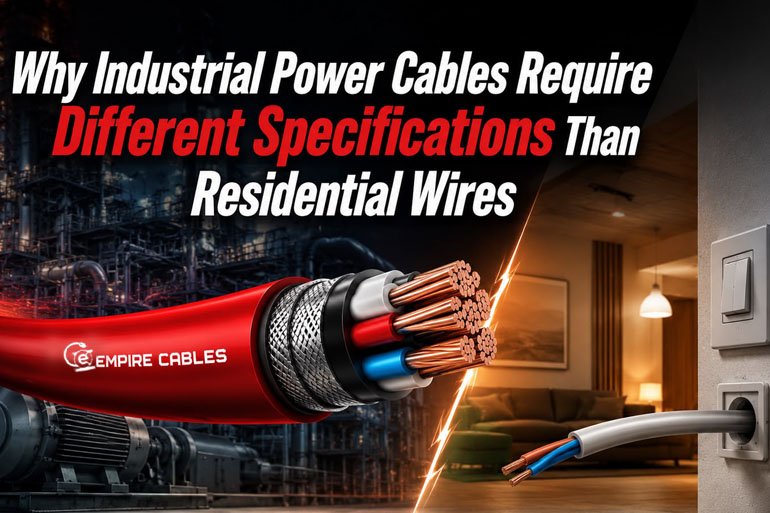
Why Industrial Power Cables Require Different Specifications Than Residential Wires
The right power cable makes all the difference in terms of long life, safety and performance, depending on the environment in which it is used. Residential wires and industrial power cables may appear to be the same, but they are engineered to work under vastly different conditions. Electrical systems in factories, manufacturing plants, warehouses, and heavy machinery are sturdier than those in homes. Knowing these differences can help you choose the right power cord, boost efficiency and minimise electrical hazards.
Different Power Requirements
Industrial buildings use a lot more power than residential buildings. Industrial power cables are used to deliver large amounts of power to heavy machinery, motors, pumps, production equipment, etc., without overheating. Residential wiring is suitable for small electrical loads, lighting, and household appliances. Industrial and residential wires have different applications and cannot be safely used interchangeably. Residential wires are not used in industrial applications, and vice versa, as they can overheat, damage insulation, or cause failure.
Stronger Insulation for Tough Conditions
Power cables are frequently exposed to heat, moisture, chemicals, oils, dust, vibration, and mechanical stresses in industrial environments. For this reason, industrial power cables are thickly insulated and have tough protective jackets. Residential wires work in much cleaner and safer indoor conditions than outdoor wires do and therefore need less protection. Improved insulation provides more cable life and a safer work environment.
Higher Safety Standards
One of the primary factors behind the different specs of industrial power cables is safety. In industrial installations, they must comply with electrical standards, as a cable failure can stop the production process, damage expensive equipment, and pose serious hazards. In times of emergency, many industrial cables are fitted with flame-retardant, fire-resistant or low-smoke insulation to minimise the risk. Residential wiring is also safe, but the demands are not as stringent as those for commercial wiring, since electrical loads are not as heavy.
Improved Performance with Heavy Load
There is a lot of industrial equipment that operates for extended periods. The power cable should perform well under any constant load. The purpose of industrial cables is to minimise power loss, provide the flexibility to move frequently when needed, and resist wear over time. Residential wires are designed for normal household requirements and continuous heavy-duty use.
Selecting the Appropriate Cable
Choosing the right power cord goes beyond just being a conduit for power. Always take into account the voltage rating, conductor size, insulation type, temperature resistance, flexibility, and environment. An incorrect cable can lead to lower efficiency, higher maintenance costs, and a shorter lifespan for electrical systems. Matching the cable to the application ensures reliability and safety.
There are some differences between industrial and home wiring, and it is important to understand them to avoid costly mistakes. If you have more questions about industrial power cables and their use, Empire Cable offers valuable knowledge on cable solutions and industry practices.
FAQs
1. can’t residential wires be used in industrial applications?
Residential wires cannot safely handle heavy electrical loads, harsh environments, continuous operation, or industrial machinery. Industrial power cables provide stronger insulation, higher current capacity, greater durability, and improved safety for demanding conditions.
2. What makes industrial power cables more durable?
Industrial power cables use thicker insulation, stronger protective jackets, higher-conductivity materials, and resistance to heat, moisture, chemicals, abrasion, vibration, and mechanical impact, making them suitable for challenging working environments.
3. How do industrial cables improve workplace safety?
Industrial cables reduce electrical failures through better insulation, flame-resistant materials, proper voltage ratings, and reliable performance. These features significantly reduce fire risks, equipment damage, unexpected downtime, and workplace electrical hazards.
4. What factors should be checked before selecting a power cable?
Important factors include voltage rating, current capacity, conductor size, insulation material, operating temperature, flexibility, environmental conditions, installation method, and compliance with relevant electrical safety standards and regulations.
5. Do industrial power cables last longer than residential wires?
Yes. Industrial power cables are engineered for continuous heavy-duty operation and harsh environments. With correct installation and maintenance, they generally offer longer service life than standard residential electrical wires.