
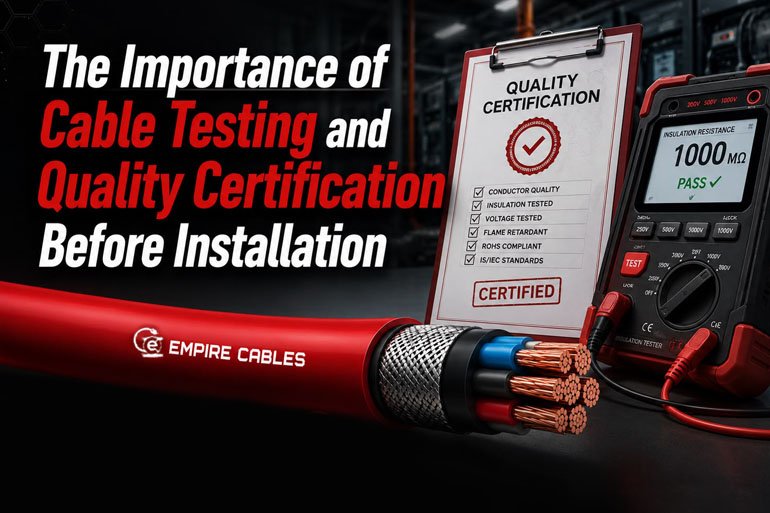
The Importance of Cable Testing and Quality Certification Before Installation
Failing to test the electrical cable run could result in serious safety and performance problems. All cables need to be tested for quality and certified before installation to ensure they comply with industry standards. Verified cables enhance long-term reliability and minimise risks in any type of project, whether it is a home, an office, a factory, or an infrastructure. However, the easiest way to avoid future electrical failures and costly repairs is to select certified products.
Why Cable Testing Matters
Cable testing is used to determine if a cable functions properly under various electrical and environmental loadings. Manufacturers consider insulation strength, conductor resistance, voltage strength, flexibility and durability. These tests are used to detect manufacturing defects before the cable gets to the installation site.
A tested cable offers consistent electrical performance and reduces the risk of short circuits, power loss and overheating. This also enhances operational efficiency by minimising unplanned downtime for maintenance and repair.
The Importance of Quality Certification
A quality-certified cable has been successfully tested to meet recognised safety standards. Certification verifies that the cable has been produced with approved materials and production processes.
Quality certification is crucial because it assures that the cable can carry the electrical load it was designed for. For projects, certified products also meet building regulations and industrial safety requirements, ensuring project approvals.
Tests Before Installation of Cables
Several important tests help ensure the quality of the cable before installation:
- The insulation resistance test is used to test the performance of the insulation.
- The continuity test is used to verify that there is no electrical break.
- The high-voltage test is a test of insulation strength under high voltage.
- The conductor resistance test is used to check the electrical efficiency.
- The mechanical strength test assesses flexibility and durability during handling.
These tests provide a comprehensive check to ensure the cable is safe and reliable for installation.
Advantages of Using Tested and Certified Cables
Tested electrical cables offer several long-term benefits. They make electrical systems safer, less prone to failure, longer-lasting, and provide more stable power transmission. Tested cables also need to be less prone to repairs, which reduces long-term costs.
Reports from the industry show that inadequate electrical connections and substandard wiring remain major causes of electrical fires. Opting for certified cables can help mitigate these risks and ensure reliable electrical systems.
Things to Check Before Installation
Always check the certification markings, physically inspect the cable for damage, check the size of the cable, check test reports if available and check the cable to see if it conforms to the project voltage and environment before installing. This careful examination will prevent costly mistakes later in the installation.
Cable testing and certification are not only a wise safety investment but also an investment in efficiency and durability. Reliable electrical systems start with reliable cables, and rigorous testing and certification processes improve all products used in an installation.
Empire Cable places a high priority on providing products that conform to known quality standards, allowing businesses to select the most suitable cable for their electrical applications, ensuring safe and reliable operation.
FAQs
1. Why is cable testing important before installation?
Cable testing identifies defects, confirms electrical performance, and ensures safety before installation. It reduces the risk of short circuits, overheating, equipment damage, and unexpected electrical failures during regular operation.
2. What is quality certification for electrical cables?
Quality certification confirms that a cable has passed recognised safety and performance tests. It verifies compliance with industry standards, ensuring reliable operation, consistent manufacturing quality, and safe electrical performance.
3. Which tests are commonly performed on electrical cables?
Common cable tests include insulation resistance, continuity, conductor resistance, high-voltage, and mechanical strength tests. These evaluations confirm durability, electrical efficiency, safety, and readiness before installation in various applications.
4. Can certified cables reduce maintenance costs?
Yes. Certified and properly tested cables usually perform more reliably, reducing breakdowns, repair frequency, replacement costs, and downtime while improving the overall lifespan of the electrical system.
5. How can I verify if a cable is quality certified?
Check the cable markings, certification labels, manufacturer documentation, and test certificates. Purchasing from reputable manufacturers also helps ensure the cable complies with recognised quality and safety standards.