

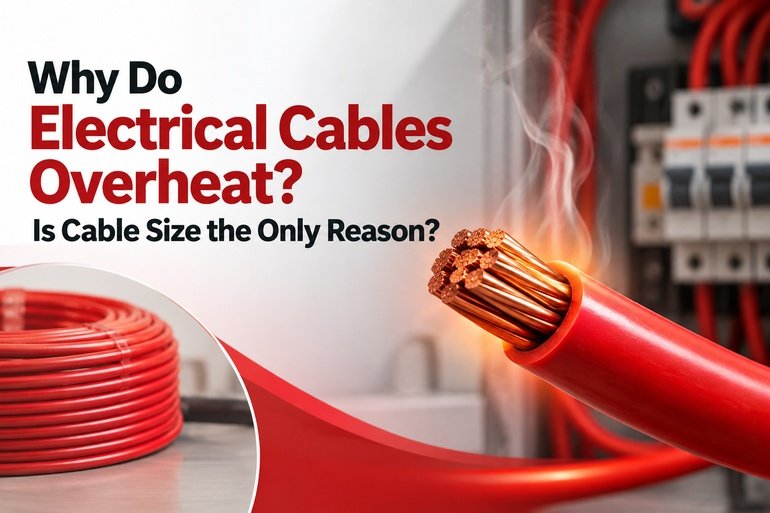
Why Do Electrical Cables Overheat? Is Cable Size the Only Reason?
Electrical cables are designed to carry current safely, but overheating can occur when the cable operates beyond its suitable conditions. While choosing the right cable size is important, it is not the only factor responsible for excessive heat. Poor connections, overloading, high ambient temperatures, damaged insulation, improper installation, and harmonics can also increase cable temperature. Understanding these causes helps prevent power losses, insulation damage, equipment failure, and potential electrical hazards. Whether cables are used in homes, offices, factories, or commercial buildings, proper selection and installation are essential for reliable performance. In this blog, Empire Cables explains the common reasons behind cable overheating and why looking beyond cable size is important when designing or maintaining an electrical system.
Why Do Electrical Cables Overheat?
An electrical cable produces some heat when current flows through its conductor because of electrical resistance. Under normal operating conditions, this heat is dissipated into the surrounding environment.
Problems arise when the heat generated becomes greater than the heat that the cable can safely dissipate. Several factors can cause this imbalance.
1. Undersized Cable
Cable size is certainly an important factor. A cable with a conductor that is too small for the amount of current being carried has higher resistance and can become excessively hot.
For example, using a cable designed for a lower current to supply a high-power appliance can cause continuous heating. Therefore, cable size should always be selected according to the expected load and applicable electrical standards.
However, simply installing a larger cable does not automatically solve every overheating problem.
2. Electrical Overloading
Even a correctly sized cable can overheat if the connected load exceeds the intended circuit capacity.
When several high-power appliances or machines operate on the same circuit, the current may rise beyond the cable’s continuous current-carrying capacity. Prolonged overloading can increase conductor temperature and gradually damage insulation.
Regularly checking circuit loads is therefore important, especially in industrial and commercial installations.
3. Loose or Poor Electrical Connections
A loose terminal, poorly tightened lug, or weak joint can create increased contact resistance. This resistance produces localized heat at the connection point.
In some cases, the cable itself may remain relatively cool while the terminal becomes extremely hot. Regular inspection and proper termination can help identify this problem before it causes serious damage.
4. High Ambient Temperature
Cable current ratings are generally based on specific environmental conditions. When cables operate in areas with high temperatures, their ability to dissipate heat can decrease.
This is particularly relevant in:
- Boiler rooms and industrial plants
- Rooftop installations
- Enclosed electrical spaces
- Areas exposed to direct sunlight
- High-temperature manufacturing environments
Appropriate derating may be necessary when operating conditions differ from the conditions used for standard cable ratings.
5. Poor Cable Installation
The way a cable is installed can significantly affect its temperature.
Cables installed too closely together may not release heat effectively. Similarly, placing cables inside poorly ventilated conduits or ducts can reduce heat dissipation.
Excessive bending, incorrect routing, or installation near other heat-producing equipment can also affect cable performance.
Is Cable Size the Only Reason for Overheating?
No. Cable size is only one part of the equation.
Factor | How It Can Cause Heating |
Undersized cable | Higher resistance and conductor temperature |
Excessive load | Current exceeds the intended capacity |
Loose connection | Increased contact resistance creates localized heat |
High ambient temperature | Reduces heat dissipation |
Cable grouping | Limits natural cooling |
Poor ventilation | Traps heat around the cable |
Damaged insulation | Can contribute to electrical faults |
Harmonic currents | May increase conductor heating |
This is why troubleshooting should consider the entire electrical installation rather than focusing only on conductor size.
Why Choosing a Reliable Cable Brand Matters
A quality cable should offer consistent conductor performance, dependable insulation, and suitability for its intended application. However, even a high-quality cable needs correct sizing, installation, protection, and maintenance to operate safely.
When selecting electrical cables, consider the conductor material, insulation type, voltage rating, current-carrying capacity, installation environment, and applicable standards. Empire Cables can be considered when looking for dependable cable solutions for different electrical applications.
Conclusion
Cable size is an important reason why electrical cables overheat, but it is not the only one. Overloading, loose connections, high temperatures, poor installation, cable grouping, damaged insulation, and harmonic currents can all contribute to excessive heating. Identifying the actual cause is essential because simply replacing an overheating cable with a larger one may not address the underlying problem. Proper cable selection, installation, inspection, and maintenance together help improve electrical safety and system reliability. For dependable cable solutions suited to different applications, explore the range offered by Empire Cables.
FAQs
Yes. An oversized cable can still become hot because of overloading, poor connections, high ambient temperatures, improper installation, or other electrical problems.
2. How does cable size affect heating?
A smaller conductor generally has higher resistance. When excessive current passes through it, more heat can be generated, potentially causing the cable temperature to rise.
3. Can a loose connection cause cable overheating?
Yes. A loose connection can increase contact resistance and create concentrated heating at terminals, joints, or connectors.
4. Does cable length affect overheating?
Yes. Longer cable runs have greater resistance and can experience voltage drop and additional heat generation, making correct cable selection important.
5. Why do cables heat up in a conduit?
Heat may accumulate when cables have limited ventilation or when several current-carrying cables are installed closely together. Installation conditions may require appropriate derating.